 Skip to content

 0
0
 0
0
Saif Alam ed. Asmara Downey
We’re all familiar with sunscreen: that greasy substance we begrudgingly apply in summer because the sun will burn us alive if we don’t ‘slip-slop-slap’. Or at least, that’s the mindset that I held for a long time. I especially disliked the ghoulish look the white cast gave me. Beyond the odd complaint, though, it wasn’t something that I gave much thought to.
Recently, amidst nights of doomscrolling, this changed. I’ve begun to engage with the cosmetic and beauty side of the internet — in particular, skincare. On one such night, I watched a creator by the handle Lab Muffin Beauty Science debunk and critically dismantle claims about sunscreen made by self-proclaimed ‘experts’ on the internet. Personally, my favourite one was when she explored the idea that you could make your own sunscreen at home using diaper cream. Spoiler alert: you can’t.
In addition to debunking cosmetic myths, her videos went into the science behind sun exposure and explored other misconceptions. Like, did you know that you can still get sunburnt on a cloudy day, or even in the shade? I didn’t! Turns out it’s because UV light can reflect off of surfaces like the water or grass. In fact, snow reflects up to 90% of UV light, meaning you can almost double your UV exposure. So even though you aren’t directly under the sun, you can still burn or tan. I was also under the impression that any clothing would be adequate for sun protection as long as your skin was covered, but I quickly learnt I was wrong. The true test for a piece of clothing’s UV protection, I discovered, is holding it up to the sun and seeing if light can still seep through, which most clothes will actually fail. This is not to mention the science behind sunscreen itself: the mechanisms of physical versus chemical sunscreens, the difference between UV-A and UV-B radiation, the discourse surrounding benzenes, what ‘SPF 50+’ actually means… I could go on.
(And for those interested in learning more about the science itself, this article does a deep dive into common sunscreen misconceptions)
Was It Ever About The Sunscreen?
Sun safety is, of course, important; I’m not aiming to become the first brown person in my bloodline to get skin cancer. When I really think about it, though, I think my curiosity about sunscreen came more from realising it was something of a microcosm for the seemingly mundane aspects of our day-to-day lives. That is, something that looks simple on the surface, but has a rich history and body of knowledge from which it originated.
For example, it’s theorised that the Ancient Greeks used olive oil as sunscreen, which was, some might say, pretty cooked. In more recent history, sun creams were invented with the goal to “tan with ease”:
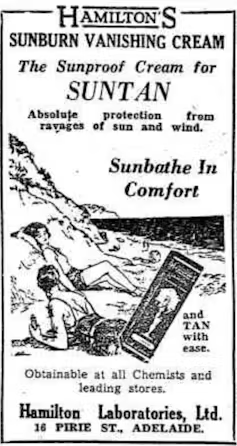
Tanning, of course, is your body’s desperate measure to stop UV from rapidly killing your cells, so there’s an obvious irony to calling this product “protection”. As modern science developed, the dangers of UV radiation were further uncovered, and sunscreens were invented to counteract (rather than accelerate) the effects. Nowadays, rigorous tests and trials are done to not only maximise sun safety but also optimise the consumer’s experience using the sunscreen. We currently have SPF 100 sunscreens capable of blocking 99% of all UVB light — a feat which took hundreds of years of experience and science to accomplish.
The more I thought about it, the more I’ve realised that I don’t stop to think about the stories behind the things I encounter in everyday life. Beyond that, I also feel as though I’m less critical with how I interact with those same things. Perhaps I could attribute that to a day and age where short-form content compromises depth for quantity, only giving mere – and oftentimes inaccurate – glimpses of the world. Hank Green recently made a video which details the grossly inflated concerns people make regarding AI’s water usage. All the while, the popular social media consensus states that water consumption from AI will irreversibly damage the environment and ruin the world.
When I think about sunscreen now, I think back to how little I knew before my deep dive — one catalysed by a night of doomscrolling. In addition to what we learn in the classroom, I think we should all strive to look more deeply at the world around us; if we use curiosity as a stepping stone to learning, there are limitless possibilities.


Average Rating