 Skip to content

 1
1
 0
0
Angelina Liu ed. Om Mirashi
“She said that everything had colour in her thought; the months of the year ran through all the tints of the spectrum, the days of the week were arrayed as Solomon in his glory, morning was golden, noon orange, evening crystal blue, and night violet. Every idea came to her mind robed in its own especial hue.”
― L.M. Montgomery, The Golden Road
For centuries, writers have wielded metaphors as a tool to capture perception, specifically what Nietzsche called “dissolving an image into a concept.” Over time, certain associations recur often enough to become convention: white as a symbol of purity, seeing red for anger. These pairings settle into the cultural psyche, acting as inspiration and a framework for future writers to build upon, or paradoxically subvert. For most people, such associations are merely symbolic. But for roughly four percent of the population, the pairing is literal in that certain senses are irrevocably tied to another. While we may see the letter a as merely a typographical character, to certain people, it may manifest as a shade of weathered wood. But it’s not just limited to colours, sounds or music can be associated with corresponding shapes. And for some, reading this passage may even invoke a particular taste.
The ability to see sounds, hear colours and taste words, officially known as synaesthesia (and those who have this extraordinary ability are called synaesthetes), is not a new phenomena. Although the term was first coined in 1892, it was first documented in 1812 by German physician Georg Tobias Ludwig Sachs, who described his own experience of associating colors with letters, musical tones, numbers, and days of the week. Interest in synaesthesia surged after 1880, coinciding with the shift in writing styles during the Victorian Era. Rich sensory descriptions and elaborate vocabulary were embraced by poets and mystics alike, although arguably did dampen synaesthesia’s scientific grounding to a literary technique. Research was further suppressed by the rise of behaviorism in 1920, as the field’s insistence on observable behavior left little room for such a condition defined almost entirely by subjective experience. Even after behaviorism waned, science remained wary of first-person accounts, partly because of the nature of human curiosity to tie explanations to their own thoughts and behaviour. Yet these explanations are often inaccurate since so much brain activity occurs below the threshold of conscious awareness. The wave of skepticism only began to lift in the late 1980s, heralding a renewed wave of synaesthesia research.
What decades of studies reveal is that synaesthesia is neither a product of fancy nor delusion, but a measurable neurological feature. Neuroimaging reveals that in synaesthetes, brain regions that were normally kept separate, would instead activate together more than in the non-synaesthetic brain, almost like the signal for one pathway spilling into another. Researchers call this “cross-activation”, and it appears to stem from heightened connectivity between adjacent sensory regions, with synaesthetic brains showing differences in white matter and cortical coupling. A related theory holds that the condition comes not from extra wiring but from incomplete pruning during development. Synaptic pruning, as it’s called, is where the brain removes weak or unused connections between neurons. In childhood, millions of extra synapses are created, but as we develop, grow and mature, specific pathways are strengthened, while unused ones are cleared.
There are two main types that synaesthetes fall under: projectors and associators. Simply, projectors will experience the sense in the physical world while associators will report the sense to be only an internal experience. There are then many subvariants, with the grapheme-colour variant being the most studied. The first word, in this case grapheme (referring to letters and numbers) signifies the “trigger” or “stimulus” while the second word, colour, refers to the sense that is associated. With all the sensory inputs in the world, there are essentially unlimited combinations with researchers documenting sound triggering color, taste triggering shape, even time units like months or days arranging themselves in fixed spatial positions. No two synaesthetes report quite the same pairings, yet within each form the associations remain remarkably stable across a lifetime, tested and retested decades apart.
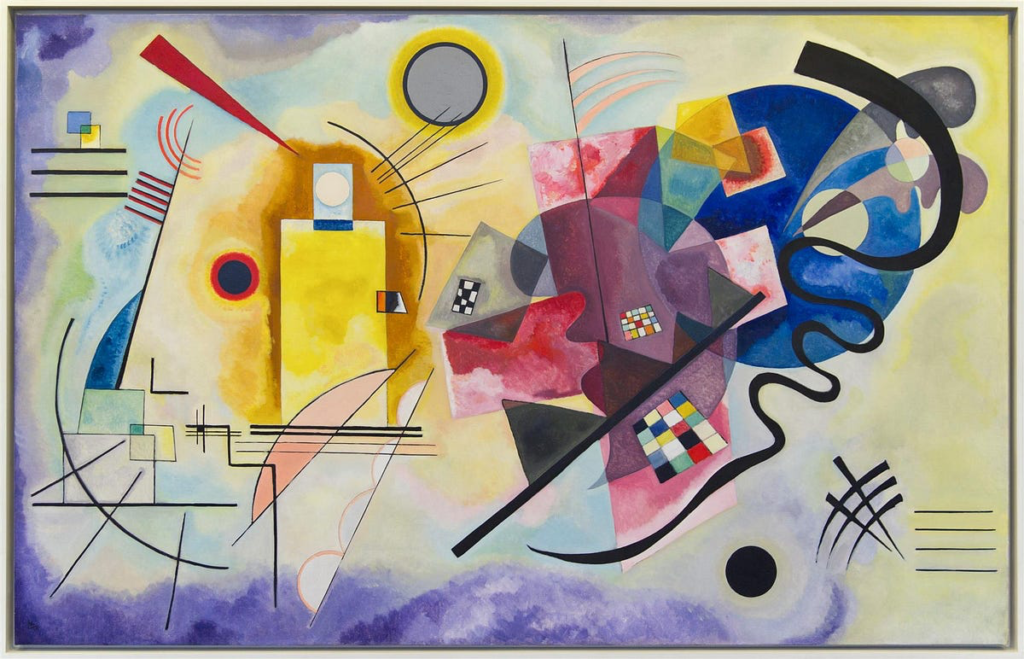
Wassily Kandinsky (1866 – 1944), was a Russian painter that experienced synaesthesia, specifically, chromosthesia, where hearing music involuntarily triggered vivid visions of colors and shapes, and conversely, painting caused him to “hear” symphonic sounds. We can get a glimpse into what his world would’ve been like in one of his most famous paintings, Yellow-Red-Blue (1925).
Whilst synaesthesia was once studied as an oddity, in the modern day it carries real clinical weight. Researchers have found synaesthesia diagnosed roughly three times more often in adults on the autism spectrum than in the general population, a link that some attribute to a shared pattern of neural over-connectivity. Moreover, studies now look to synaesthesia for clues about memory, about the neural basis of metaphor itself, even about the design of sensory substitution devices for the blind and deaf, where one sense is deliberately taught to stand in for another. Perhaps synaesthesia reminds us of the enduring fact that there was never just one way to experience the world, because to us all, our perception of reality is no less real than anyone else’s.
If you’re curious what it’s like to experience synaesthesia, Google Arts and Culture in collaboration with the Centre Pompidou in Paris, have developed a lovely interactive that brings Kandinsky’s painting to life.


Average Rating