 Skip to content

 0
0
 0
0
Fazila Olaniyan ed. Anthony Foong
You’ve probably seen their work in Jugular or on our Instagram, but have you ever wondered what goes on inside the minds of Jugular’s creatives? Is art something anyone can cultivate, or is it reserved for those with a seemingly God-given talent?
Curious to find out, I sat down with three of the Jugular’s artists: Cher, Yul and Emma, to pick their brains about their creative process, the stories behind their work, and what art really means to them.
We started the interview off pretty broad because as always, we always start with open questions.
What is art?
Yul and Cher’s answers were pretty similar. They believe art to be a form of expression, a medium through which artists can communicate their thoughts through a visual and sensory medium. For Cher, they believe that while words are easily misunderstood, art helps encapsulate the feelings in between, the feelings we wish to express but can’t quite describe.
Its ambiguity invites countless interpretations: what begins as an artist’s expression of frustration may resonate with one viewer as loneliness, another as grief, and another as the quiet confusion of navigating life. In its openness, a single piece allows everyone to find a part of themselves within it, making each viewer feel seen in their own way.
As for Yul, he sees it as a way to dip a toe into the bigger issues, to communicate and contemplate our everyday struggles or philosophical and moral dilemmas to the rest of the world.
And this left me wondering who inspired their art styles and recent works on the jugular?
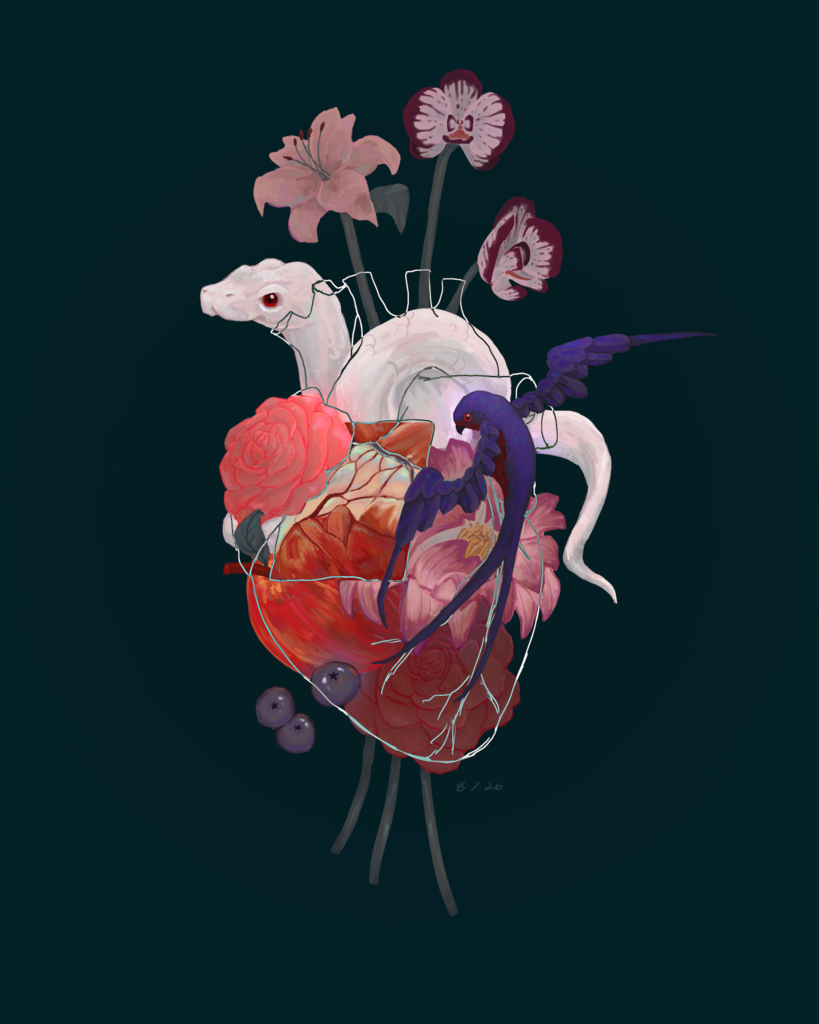
Emma is particularly drawn to nature, finding inspiration in its forms, colours and intricate patterns. She enjoys exploring colour theory; from complementary palettes to muted, desaturated tones, and is fascinated by the shapes and structures found in natural objects, whether it be the microscopic architecture of the distal and proximal convoluted tubules (DCT and PCT) or the anatomy of the human heart. One of her recent pieces, depicting the human heart, also marked her first attempt at using colour assimilation, a technique in which the illusion of blue and green is created using shades of grey.
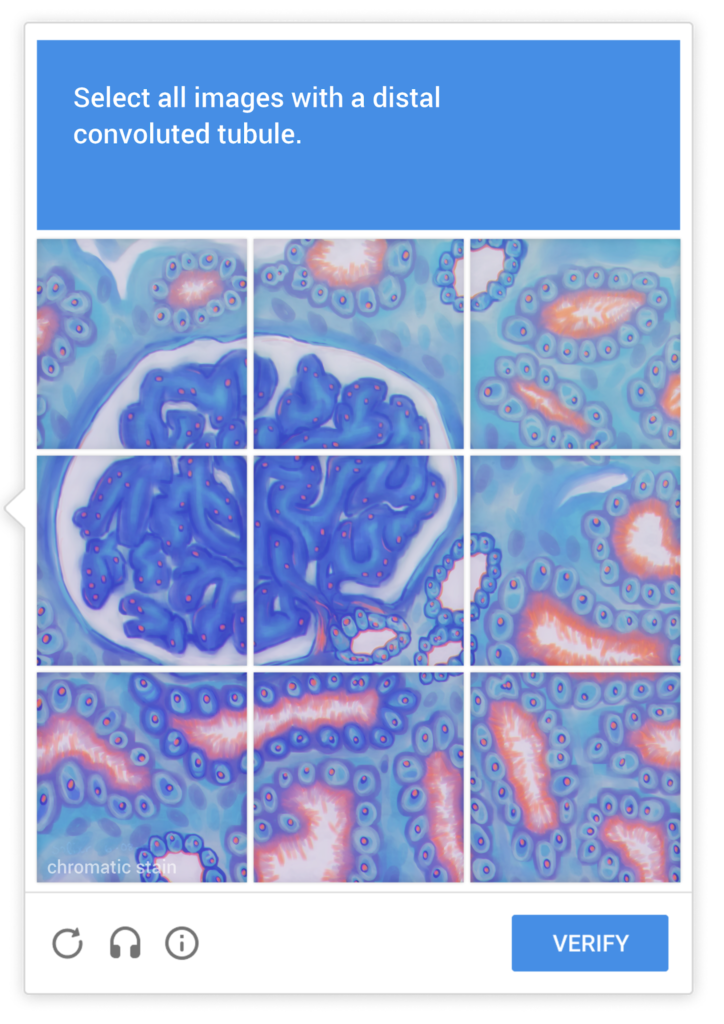
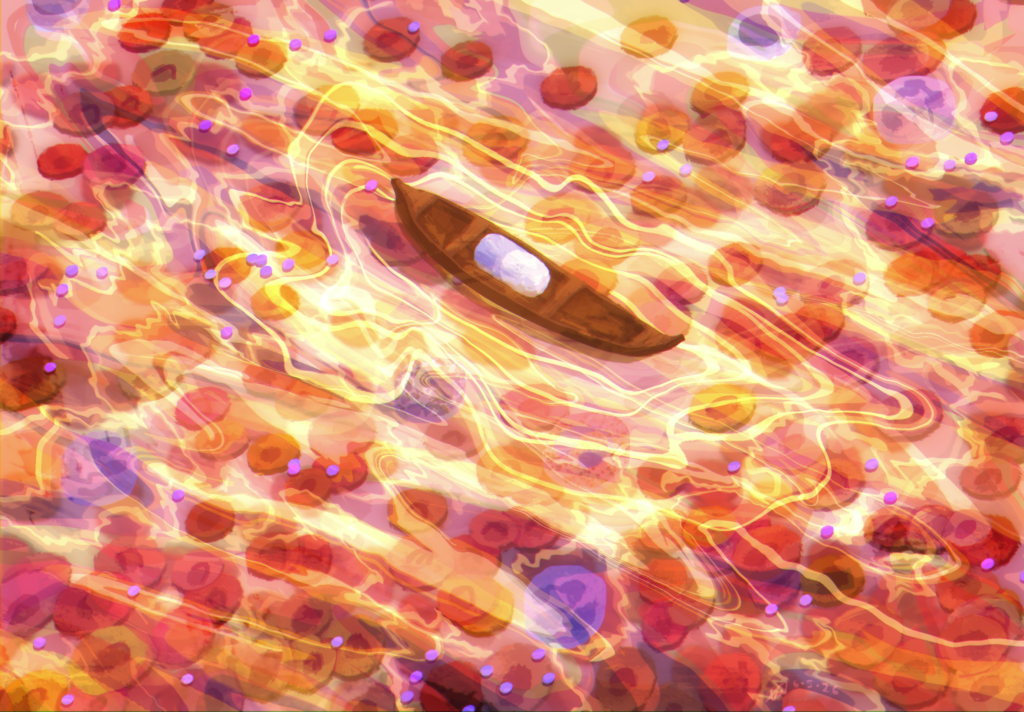
Unlike many artists, Emma doesn’t believe her work carries a profound underlying message. Instead, she simply hopes that others can appreciate the same beauty that she sees in the world around her. To her, art is not defined by the finished product, but by the catharsis found in the creative process. What makes a piece truly meaningful is the time, care and intention invested in bringing it to life.
Yul, on the other hand, sees his art as a reflection of the person he was at the moment each piece was created. His work captures his character, mindset and outlook on the world, serving as a visual record of his evolving identity. Through his art, he explores everything from serious social concerns to humour and light-heartedness, all while contemplating the kind of person he hopes to become.
A traditional artist at heart, Yul draws much of his inspiration from Caravaggio. He admires the master’s approach to composition, dramatic poses and naturalism, as well as the central ideals of the Baroque period. While these influences are evident in his work, Yul strives to reinterpret them through his own contemporary perspective.
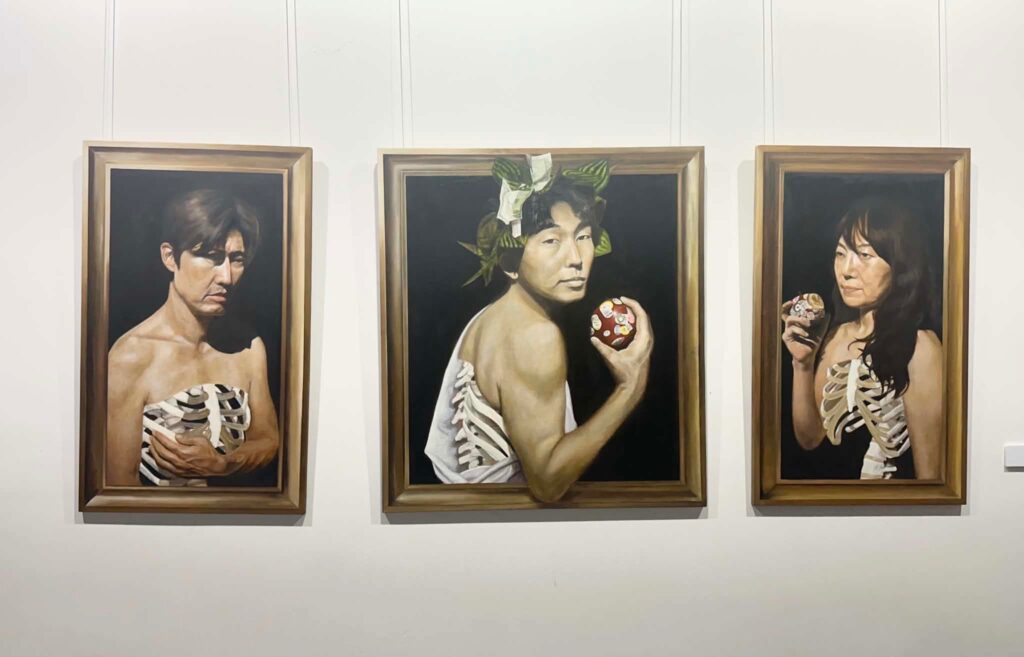
Among his favourite works is his Year 12 multi-panel oil painting, which examines society’s reverence for consumerism through a distinctly Baroque lens. The piece critiques the modern “god” of consumption, questioning the empty ideals that many of us unknowingly worship. By adopting the grandeur, theatricality and emotional intensity of Baroque art, Yul seeks to evoke the same sense of awe and spiritual transcendence that religious paintings once inspired. In doing so, he invites viewers to reflect on what he believes to have replaced faith in an increasingly secular world, and the seemingly ordinary things we have elevated to a god-like status.
Finally, we have Cher, whose work draws inspiration from an eclectic mix of artists, mediums and aesthetics, as well as industrial music and horror. They are particularly drawn to pieces rich in texture, grime and intensity. Like Yul, Cher sees art as a form of personal exploration. The visual medium offers a freedom that words often cannot, creating space for multiple interpretations while allowing them to weave layers of meaning into their reflections on themselves and the world around them.
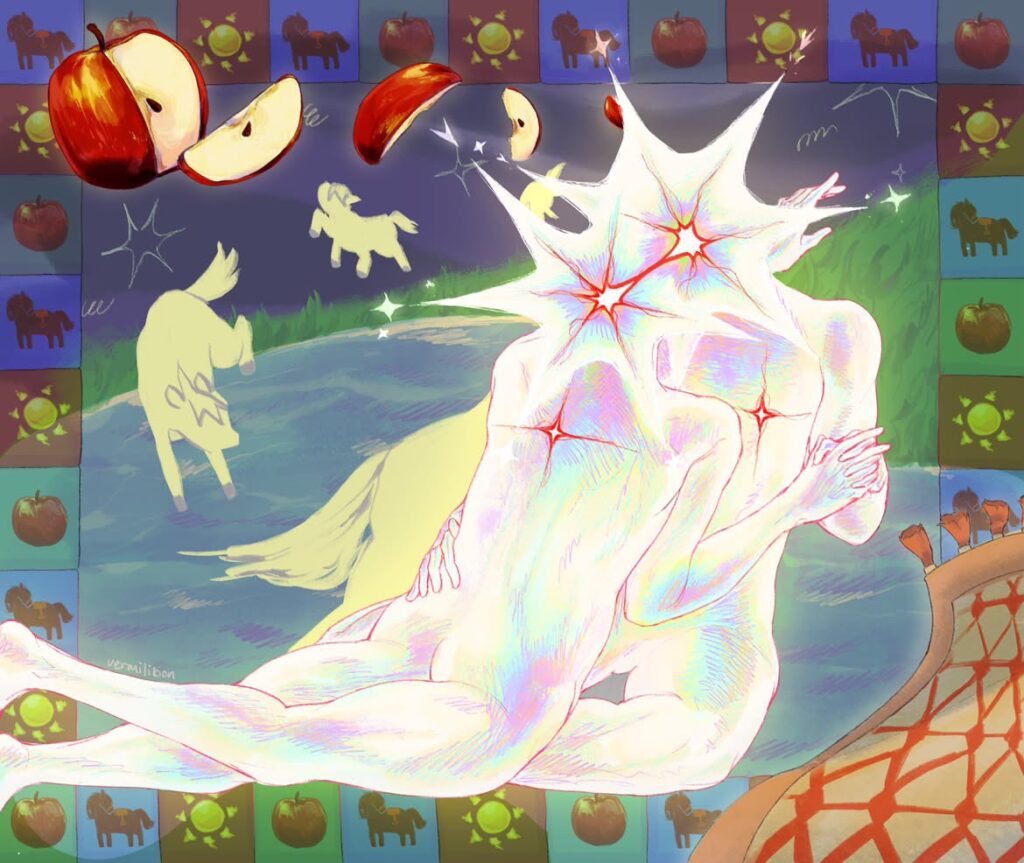
One of Cher’s recent works was inspired by Richard Siken’s poem’Scheherazade’. Rather than responding to its narrative, they were captivated by the atmosphere it evoked – the fleeting feeling of a moment slipping away. Unable to fully articulate that emotion through words alone, they turned to art to capture what language could not. In many ways, this reflects the heart of Cher’s creative philosophy: art becomes the language through which emotions too abstract or intangible for words can finally be understood, both by themselves and by those who encounter their work.
Concluding notes:
As Yul points out, creativity is often misconceptualised. Many of us convince ourselves that we’re simply “not creative enough” to make art, whether that be through painting, poetry, music or any other medium. But creativity extends far beyond the arts. It is present in the way we approach conversations, solve problems, empathise with others and navigate our everyday lives.
Emma and Cher add that creating is ultimately about the process rather than the outcome. It doesn’t matter whether a piece is “good” or “bad”, or whether anyone else ever sees it. Create for yourself. Let it be an opportunity to explore your thoughts, process your emotions, or simply make something because you felt like it.
Perhaps we’ve come to think of creativity as something extraordinary – an innate gift possessed by only a select few – when in reality it is something deeply human. In a world that constantly competes for our attention through endless streams of content, music and media, we rarely give ourselves the space to simply sit with our own thoughts. Maybe creativity begins there: by allowing ourselves to think, to feel, and to create without judgement. Who knows? You might just surprise yourself.
Until next time,
Fazila Olaniyan


Average Rating